The Most Human Part of How We Work With AI
Aug 9, 2026 · 5 min read
 MB SamuelFounder
 Ashwanth SamuelFounder
We're living in a weird time.
A frontier and an overhang
AI is advancing rapidly, but its capabilities are jagged.
It's extraordinarily good at some things, like coding, and surprisingly terrible at others, like being honest with you when your idea is bad.
Companies and people are adapting at different speeds, too. This is often called the capability overhang: AI is capable of far more than what we're using it for today.
Deployment companies are springing up left and right to tackle this at the company level, but a huge gap exists at the individual level. Companies sell AI agents without selling enablement. Companies buy AI licenses without investing in AI training.
Meanwhile, almost every benchmark of AI progress measures how well models can replace humans, not how they amplify or augment them. The focus is on the technology, not on making sure humans come along.
It's no surprise that people often feel underwhelmed, or worse, left behind.
The skills that matter
But AI can't replace humans. As Jack Dorsey has argued, the more capable the models get, the more it falls to humans to bring their unique perspectives and judgment: to shape the output by defining the goals, deciding what good looks like, and managing the environment the AI works in.
So the real question was never whether AI is capable. It's how the human will apply their uniquely human skills to shape it.
From outputs to inputs
Traditionally, skills have been most visible in our finished products: the final presentation, or blog post, or web app. Our artifacts were reflections of our process; they showed how we think and where we chose to invest our time. Now, creating is easier than ever, and polish has never been more deceptive.
The thinking has moved. It no longer lives in the output. It lives in the inputs: the prompts, the context you choose to share, the way you set up and correct your tools, what you choose to delegate and what you don't.
The thinking has moved. It no longer lives in the output. It lives in the inputs.
Hiring in the age of AI
Nowhere is this shift from outputs to inputs more challenging than in hiring.
With AI, candidates can apply to thousands of jobs at once, with resumes perfectly tailored to the role. Take-home projects like strategy memos or financial models that once separated candidates are now trivial with an LLM.
In an effort to differentiate, companies have gone back to tried-and-true methods: live interviews, whiteboards, pen and paper. These are high signal. Live interviews test for things that matter -- systems thinking, creativity, taste -- but they're also time-consuming and expensive.
There's another, more underrated way to see past the polish: let candidates use AI, but ask to see the process. Measure success not through AI capability or human skill alone, but based on what the human can accomplish with AI as a collaborator.
How this connects to Gradient
At Gradient, we do just that.
Our first product, Gradient assessments, helps teams hire AI-fluent talent by looking at how people collaborate with AI, not just what they produce.
When people think about what skills are critical in the age of AI, they talk about things like systems thinking, judgment, and a growth mindset.
We've taken these skills and used them to develop our own definition of AI fluency, with four parts:
Setup
Managing the AI's environment, tools, and context.
What this looks like
Shares the source material, names the audience, and gives the AI the right tools before asking it to work.
We've mapped each of these to a concrete set of behaviors that candidates demonstrate when they complete a Gradient assessment.
In hiring, this allows us to help companies repeatably and scalably identify people who are AI fluent: who mold and shape AI from raw intelligence into unique outputs, and want to get better at doing so over time.
Try it
Two candidates, one brief: a messy customer inbox, and a request to recommend what the team should build next. What makes the second prompt better?
Candidate A
Read these support tickets and tell me the top 3 feature requests.
Candidate B
In each Gradient session, we hold the model and the environment constant: the only thing that varies is the human, and the choices they make.
Beyond hiring
It's a growth story as much as a hiring one.
When we run trainings, every person does a pre-work exercise in Gradient on a shared problem. Then we bring the team together and surface the most interesting inputs across the group, comparisons exactly like the one above.
It's consistently a "wow" moment, because we so rarely get to see how other people structure their thinking to direct AI. And when we do get to see that, we learn fast.
AI, and how we work with it, will keep changing. But the more the outputs start to look alike, the more what sets people apart is how they got there.
By showing the process, we're able to break down the silos, and learn from the most human part of how we work with AI.
If you'd like to see how your team works with AI, reach out.
Start hiring AI fluent talent.
We’ll show you an assessment, walk through the scoring engine, and get you live in a few hours.
More from the blog
A Tale of Two Maps: Why Your Prompts Matter
I asked AI for a map twice. Once I got a spinning globe. Once I got a blob where Florida looks like a cow's udder. The blob came from the better model.
 MB Samuel
Oct 2, 2026 · 4 min read
Build a Brand Skill That Actually Works
One of the first things we help teams set up in our trainings is a /brand skill. Here's how ours is designed, part by part, with a downloadable example.
MB SamuelSep 15, 2026 · 15 min read
Gradient as a teaching tool: Lessons from a classroom pilot
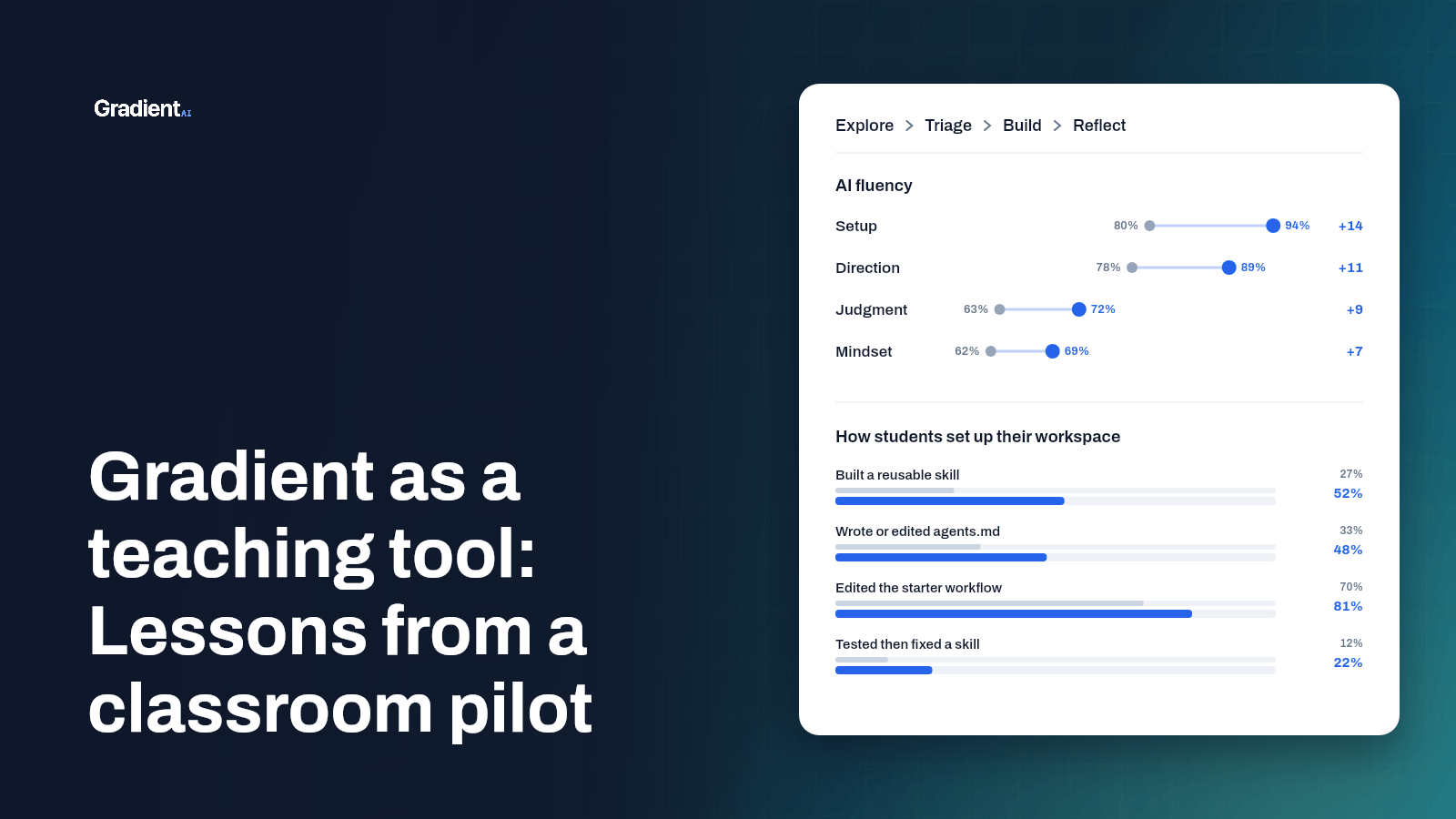
We ran Gradient as a pre- and post-test in a three-week graduate course on generative AI. What the numbers, students, and instructors taught us.
MB SamuelSep 10, 2026 · 6 min read